
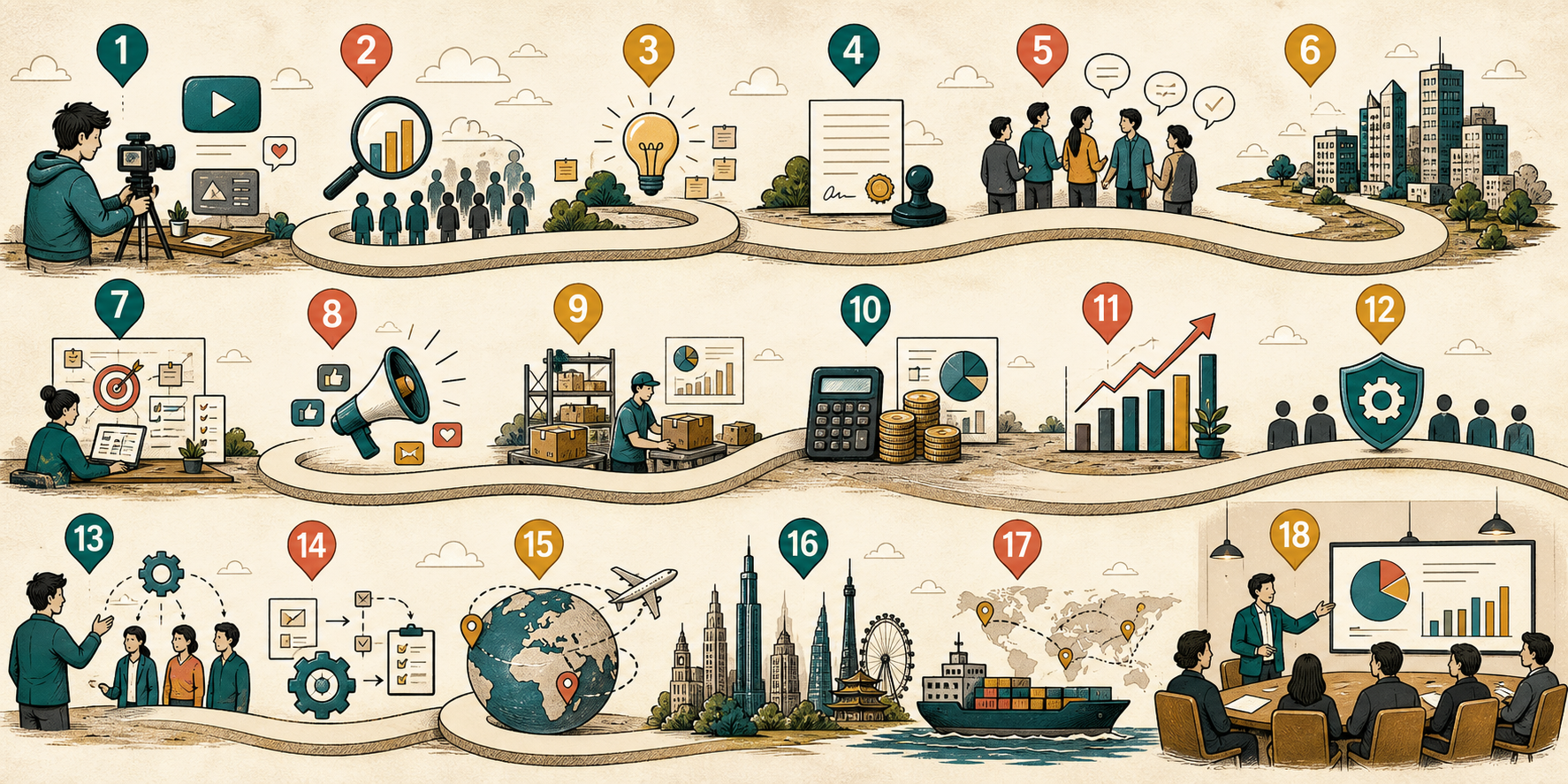
This course is built around the long teaching case Become Judy. You begin with how a cross-border creator noticed a market opportunity, then move through decisions, strategy, organization, talent, operations, marketing, cash, control, and change before proposing a company-building blueprint that could actually operate.
18週課程節奏course weeks
15週核心管理主題core management topics
1份公司建立藍圖company blueprint
開課學期Semester115 學年度第 1 學期AY 115, Semester 1
課號Course CodeCM108G
修課層級Level大學部Undergraduate
授課語言Language英文授課English-taught
本頁插圖為教學情境用圖,人物均為虛構設定,並非真實當事人肖像。The illustrations on this page are generated learning visuals. Characters are fictional and do not depict the real person in the case.
個案聲明:本課程使用的《Become Judy》屬於教學案例。素材由元智大學吳相勲副教授與 Codex 協作整理,主要依公開影片、公開報導與可查資料撰寫;Judy 本人未審閱本案例,課程團隊也未訪問 Judy 或其身邊人士。這份材料用於管理決策討論,不評價當事人或相關人士。Case note: Become Judy is used here as a teaching case. The material was prepared by Associate Professor Hsiang-Hsun Wu of Yuan Ze University in collaboration with Codex, mainly from public videos, public reports, and publicly verifiable materials. Judy has not approved this case, and neither Judy nor people around her were interviewed. The learning purpose is to study management decisions and company building, not to judge the people involved.
課程工作空間Course Workspaces
課堂活動與學習資料會在以下兩個空間進行與整理;每次活動仍請先依教師當次公告確認使用方式。Class activities and learning materials will be organized across the two spaces below. For each activity, follow the instructor’s latest announcement about how to use them.
Microsoft TeamsMicrosoft Teams
我們的課堂活動都會在 Teams 上面進行,課堂錄影及參考資料也會公布在 Teams。學校的 Portal 只作為備援方案。All class activities will take place in Teams. Class recordings and reference materials will also be posted in Teams. The university Portal is only a backup option.
這門課會有許多在 Gemini Notebook 上面進行的學習活動,學習教案跟資料也會放在上面。Many learning activities in this course will take place in Gemini Notebook. Lesson plans and supporting materials will also be posted there.
This is not a course about watching a YouTuber. It is a course about turning real entrepreneurial clues into management systems. Each week moves the case forward and asks you to convert management concepts into executable company design.
學期主軸從「機會被看見」一路走到「公司能否被管理」。The semester moves from noticing opportunity to making the company manageable.
課程故事線Narrative Arc
從個人內容創作出發,辨認市場訊號與觀眾回饋。Start with individual content creation and read market signals from audience response.
將機會整理成目標,判斷公司應該成為哪一種事業。Convert opportunity into goals and decide what the company should become.
整理多角化選項,釐清內容、啦啦隊、品牌合作與活動服務的關係。Sort diversification choices across content, cheerleading, sponsorships, and event services.
設計組織、人事、營運與品質控管,使服務交付不再只依賴創辦人。Build organization, people systems, operations, and quality control so service can be delivered reliably.
檢視資金、領導、倫理、風險與控制,判斷成長是否超過組織承受能力。Handle cash, leadership, ethics, risk, and control so growth does not depend only on the founder.
在期末提出你們版本的公司建立藍圖。End with your own version of the company-building blueprint.
You should be able to explain that market opportunity is not simply "I like it" or "the audience likes it." It is built from demand, supply, competition, channels, revenue sources, and constraints.

學習成果二:設計制度Outcome 2: Designing Systems
學生需要把工作分工、人才管理、內容品質、客戶交付、財務壓力與風險控制,整理成流程、角色與指標。
You should be able to turn division of work, talent management, content quality, customer delivery, financial pressure, and risk control into processes, roles, and metrics.
The final recommendation should not stop at "expand" or "be conservative." It must specify the business model choice and the management capabilities that must be built next.
The long case provides the public case context, industry background, and management questions that still require judgment. The short case turns one high-tension decision into a dialogue-driven scene. The course uses the long case as the core and the short case as a decision simulation entry point. Read both with four roles in view: the creator or public brand, the party making the external promise or transaction, the people performing the work, and the party receiving money or bearing consequences. These roles may belong to one person, several people, or different organizations.
The long case moves from travel videos, channel growth, cross-border cheerleading supply, Taiwanese sports-entertainment demand, YouTuber monetization pressure, talent contracts, and cash pressure. It asks: when one person's content energy begins to look like a company opportunity, should the manager expand, institutionalize, or narrow the business model first? Public registration data in the case is used only as a dated, narrow record; it does not assign every activity to one particular legal entity.
The short case simplifies the context into one scene: a founder faces a team contract that could sharply increase visibility, while also adding pressure on people, rehearsals, content, cash, and morale. The dialogue reveals how the same decision looks different to the founder, operations lead, captain, brand side, and financial advisor.
創作者的觀眾資產,何時可以變成公司資產?When can a creator's audience asset become a company asset?
跨國創業者如何讀懂本地市場需求,而不是直接搬用原生市場的做法?How can a cross-border entrepreneur read local demand instead of simply importing practices from the home market?
啦啦隊業務牽涉球隊、表演者、媒體、粉絲與品牌,真正付費與承擔風險的是誰?When cheerleading work involves teams, performers, media, fans, and brands, who is the real customer?
當流量收入不足以支持團隊,業配、活動、經紀與服務收入應該如何組合?When traffic revenue cannot support the team, how should sponsorships, events, agency work, and services be combined?
創辦人如何從被信任的人,轉為能設計制度的人?How does the founder move from being the trusted person to designing systems that others can rely on?
個案生態圈:內容平台、粉絲、球隊、品牌、媒體、表演者與跨國夥伴之間互相拉動。Case ecosystem: platforms, fans, teams, brands, media, performers, and cross-border partners pull on one another.
Weeks 1 and 9 are used for orientation and midterm progress review rather than full formal lectures. Weeks 17 and 18 are flexible teaching weeks, but classes will meet as usual. Weeks 4 and 8 are self-directed learning weeks because of holidays. The remaining weeks move through core management topics; each week produces one management tool that accumulates into the final report.
展開週卡可看到課前、課中、作業與自學指引。Open a week card to see preparation, in-class work, assignment, and self-learning guidance.
Semester dates: Week 1 begins on September 7, 2026. Week 4 (September 28, Teachers' Day holiday) and Week 8 (October 26, Retrocession Day make-up holiday) are self-directed learning weeks. The final exam remains scheduled for Week 16 on December 21; Weeks 17 and 18 are flexible teaching weeks, but classes will meet as usual, and the semester officially ends on January 4, 2027.
專案如何累積成期末成果How the Project Builds Toward the Final
Your team project is not a separate assignment. Each week helps you understand one more piece of the case company. By the final, the tools combine into your version of the Judy company: customers, value proposition, revenue mix, organization, operations, cash needs, and risk controls.
This is a cross-cultural course with one shared project. The class includes 61 students, including 37 international students from 13 nationalities. Different passports do not automatically create a good team. Teams are formed around communication, reliability, mutual support, and visible work from every member—not around finding the strongest English speaker.
分組時間線Team Formation Timeline
第一天不會直接固定整學期的分組。前兩週先用短任務觀察大家如何溝通與合作,再形成能真正工作的團隊。
Semester teams will not be fixed on Day 1. The first two weeks use short tasks to observe how classmates communicate and work together before formal teams are formed.
時間When
安排Arrangement
你需要做什麼What You Do
第 1–2 週Weeks 1–2
與不同同學完成短任務Short tasks with different classmates
留下自己的證據與判斷,觀察溝通、守時與互相支援的情況。Leave your own evidence and judgment, and observe communication, reliability, and mutual support.
第 3 週Week 3
公布正式分組Formal teams announced
開始建立團隊資料庫、分配可看見的角色,並完成第一次團隊健康檢核。Start the team evidence base, assign visible roles, and complete the first team-health check.
第 5 週Week 5
必要時的調整窗口Controlled adjustment window
若分工、溝通或參與出現實際問題,請提早向教師反映;調整依教師判斷處理。If roles, communication, or participation are not working, report it early; adjustments are handled by the instructor.
第 9 週起Week 9 onward
專案檢核與深入工作Project checks and deeper work
依據證據、假設、資料缺口與個人貢獻,持續修正期末公司的建立藍圖。Use evidence, assumptions, data gaps, and individual contributions to keep revising the company-building blueprint.
A good team does not depend on one “best English speaker” doing all the communication. Every member needs a visible role. Roles can rotate, and helping is expected, but one person should not do all the work for others.
溝通橋接者Communication bridge:確認大家理解相同、邀請安靜的成員發言,必要時放慢討論速度。Checks shared understanding, invites quiet members to speak, and slows the discussion when needed.
進度推進者Progress driver:把討論轉成分工、期限、下一步與共同決定。Turns discussion into tasks, deadlines, next steps, and shared decisions.
小組討論固定流程Discussion Protocol
先留下個人判斷,再把證據帶進團隊。這樣可以降低臨場使用英文的壓力,也避免小組只剩一個人替大家發言。
Write your own judgment first, then bring the evidence into the team. This lowers the pressure of speaking English on the spot and keeps one person from speaking for everyone.
個人先寫:留下自己的證據與暫定判斷。Write alone: record your evidence and tentative judgment.
兩人說明:向同伴解釋一次,確認彼此理解。Talk in pairs: explain once and check shared understanding.
小組統整:說明同意或不同意的理由。Team summary: explain why the team agrees or disagrees.
跨組挑戰:接受其他小組提問,測試想法。Cross-team challenge: test the idea through questions from another team.
修正答案:根據證據與提問改善成果。Revise: improve the work based on evidence and questions.
A quiet team is not always a healthy team. We check team health in Week 3, keep an adjustment window in Week 5, review the midterm project in Week 9, and check risk and contribution in Week 13. Tell the instructor early if you do not understand the team direction, cannot join the discussion, see one person doing everything, or feel excluded.
第 1 週Week 1
建立團隊資料庫。你們開始蒐集個案證據、外部資料、影片線索、產業資訊與待查問題。
Build the team evidence base. Start collecting case evidence, external sources, video clues, industry information, and unresolved questions.
起點Start
第 5 週Week 5
整理公司目標與商業模式草案,說明你們認為公司最該處理的經營問題。
Turn the material into a draft of company goals and business model, explaining the core problem the company should solve.
初版假設First hypothesis
第 9 週Week 9
提交期中進度包。評估重點不在答案漂亮,而在證據是否清楚、假設能否檢驗、下一步資料缺口是否明確。
Submit the midterm progress package. The goal is not a perfect answer; it is clear evidence, testable assumptions, and explicit data gaps.
期中檢核Midterm check
第 13 週Week 13
完成收入與資金壓力分析。每一個成長選項都要說清楚現金流、固定成本、人才成本與風險。
Complete the revenue and cash-pressure analysis. Every growth option must clarify cash flow, fixed costs, talent costs, and risk.
財務壓力Cash pressure
第 17 週Week 17
提出期末個案分析與建議。你們需要選擇一條成長路線,並說明相對應的管理制度。
Present the final case analysis and recommendation. Choose a growth path and explain the management system that supports it.
期末建議Final recommendation
第 18 週Week 18
將期末建議修訂為公司建立藍圖。讀者應該看得出來:如果你們真的接手這家公司,下一季會先處理什麼。
Revise the final recommendation into a company-building blueprint. The reader should understand what your team would do first next quarter if you actually took over the company.
The item dated September 6, 2026 is for demonstration only and does not need to be submitted. The item shown in Teams with a September 6 deadline is used in class to demonstrate how assignments and Rubrics work. It is not a formal student assignment, is not graded, and is not subject to the late policy. Follow the latest weekly assignment posted in Teams for the actual requirements.
作業的一般規範General Assignment Rules
以下是個人與小組作業共用的基本原則。每週 Teams 作業會再說明本週要完成的工具、檔案格式、AI 使用模式、截止時間與 Rubric 焦點;如果當週說明更具體,請以教師最新發布的 Teams 作業為準。
These are the shared baseline rules for individual and team assignments. Each weekly Teams assignment will state the required tool, file format, AI-use mode, deadline, and Rubric focus. When a weekly instruction is more specific, follow the instructor's latest Teams assignment.
個人作業Individual Work
由本人繳交;作業本體與 log 都要能辨識學號與正式中文姓名。Submit your own work; both the assignment and the log must identify your student ID and official Chinese name.
保留自己的第一判斷、使用的證據、查證結果,以及最後修改或放棄某個想法的理由。Keep your first judgment, evidence, verification, and reasons for revising or rejecting an idea.
若使用 AI,依當週指示留下工具、日期、用途、查證與個人修正紀錄;若未使用,也要在 log 中說明未使用 AI 與自己的判斷過程。If AI is used, record the tool, date, purpose, verification, and personal revisions as instructed. If AI is not used, state that clearly and record your own reasoning process.
小組作業Team Work
一般由一位代表繳交,但作業本體必須列出全體組員的學號與正式中文姓名。Normally one representative submits, but the assignment must list every member's student ID and official Chinese name.
寫出分工、實際貢獻與共同決定;小組作業不能由一人代替全組完成。Record roles, actual contributions, and shared decisions; one person may not do the entire team assignment for everyone.
若不同成員使用 AI,應在共同 log 中分別列出每人的使用/未使用聲明與可追溯紀錄。If members use AI differently, the shared log must identify each member's use or non-use statement and traceable record.
共同要求Shared Requirement
學生要確認的事What to Check
作業本體與 logAssignment and log
除當週 Teams 另有指定,作業本體與工作紀錄要一起提交;檔案格式與命名依當週說明。Unless the weekly Teams assignment says otherwise, submit the assignment and work log together; follow the weekly format and naming instructions.
證據與來源Evidence and sources
重要判斷要連結個案證據或可查證的外部資料;資料不足時直接標明,不自行補造數字與引用。Connect important judgments to case evidence or checkable external sources; label gaps instead of inventing numbers or citations.
格式門檻與遲交Format gate and lateness
缺少作業本體、log、完整組員名單或必要的 AI 證據時,先依 Teams 指示補件/重送;遲交判定以 Teams 紀錄時間為準。If the assignment, log, full member list, or required AI evidence is missing, resubmit as instructed before content grading; lateness is determined by the Teams record.
Weekly case-tool assignments share a 100-point Rubric with four criteria worth 25 points each. The Rubric makes observable evidence clear rather than asking students to guess what the instructor wants. Each weekly Teams assignment will identify the most important focus for that week. The Rubric itself does not grant permission to use AI; follow the instructor's AI-use instruction.
面向Criterion
配分Points
主要看什麼What It Looks For
R1|管理學概念與問題理解R1 | Management concept and problem understanding
25
是否準確定義本週管理問題、正確使用概念,並說明它為何適用於個案。Accurate definition of the week's management problem, correct use of the concept, and a clear case connection.
R2|證據、來源與個案應用R2 | Evidence, sources, and case application
25
主要判斷是否有具體證據或清楚標示的假設,來源能否查核,限制是否說明。Major judgments are supported by specific evidence or labeled assumptions, with checkable sources and stated limits.
R3|管理工具與實際使用R3 | Management tool and practical use
25
指定工具是否完整、具體、可使用,能否支持管理決策或下一步行動。The required tool is complete, specific, usable, and able to support a management decision or next step.
R4|推理、修正與責任R4 | Reasoning, revision, and responsibility
25
log 是否可追溯,能否看出原始判斷、查證、AI 使用(如有)、修正理由與每位組員的實際貢獻。The log is traceable and shows the starting judgment, verification, AI use if any, revision reasons, and each member's actual contribution.
四個評分層級Four Performance Levels
4|優良:22–25 分4 | Excellent: 22–25:證據具體、工具可用,推理與修正完整。Specific evidence, a usable tool, and a complete reasoning and revision trail.
3|良好:17–21 分3 | Good: 17–21:主要要求已達成,只有少數細節需要補強。The main requirements are met, with only a few details needing improvement.
2|發展中:10–16 分2 | Developing: 10–16:有相關內容,但概念、證據或工具仍不完整。Relevant work is present, but the concept, evidence, or tool remains incomplete.
1|需要修正:1–9 分1 | Needs revision: 1–9:大多是名詞、摘要或意見,尚不能支撐管理判斷。The work is mostly terms, summary, or opinion and cannot yet support a management judgment.
0|無可評量內容:0 分0 | No assessable work: 0:沒有提交可評量的內容。No assessable work is submitted.
先通過格式門檻Pass the Format Gate First
先確認作業本體與 log 都存在、可讀,且符合當週指定格式。First confirm that the assignment and log are present, readable, and in the required format.
使用 AI 時,確認有可追溯的 Exporter 證據;未使用 AI 時,提交清楚的未使用聲明與來源/推理紀錄。When AI is used, include traceable exporter evidence; when it is not used, include a clear non-use statement and source and reasoning record.
小組作業確認完整組員名單與每人貢獻,再進入 100 分 Rubric 評分。For team work, confirm the full member list and each contribution before applying the 100-point Rubric.
格式門檻未通過時,依教師指示補件/重送;Rubric 不會把格式缺失直接當成內容零分。If the format gate is not met, resubmit as instructed; a format problem is handled before content points are assigned.
學期成績比例Semester Grade Weighting
每週概念診斷小考:15%Weekly concept quizzes: 15%
每週個案作業與 AI 對話紀錄:30%Weekly case assignments and AI dialogue records: 30%
期中考:15%Midterm exam: 15%
期末考:15%Final exam: 15%
期末個案整體評估方案:20%Final case evaluation plan: 20%
個人反思與同儕互評:5%Individual reflection and peer evaluation: 5%
期中進度包Midterm Progress Package
一頁式管理判斷:目前最重要的決策問題與暫定立場。One-page management judgment: the most important decision issue and tentative position.
資料證據表:事實、推論、未知與查證優先順序。Evidence table: facts, inferences, unknowns, and verification priorities.
事業組合圖:內容、啦啦隊、品牌合作與活動服務的關係。Business portfolio map: relationships among content, cheerleading, sponsorships, and event services.
初步營運方案:人力、流程、收入與成本假設。Initial operating plan: people, process, revenue, and cost assumptions.
待查證清單:最可能改變結論的資料缺口。Verification list: data gaps most likely to change the conclusion.
期末成果要呈現一家公司如何被經營,而不只是把故事說得精彩。The final output should present a company that can be managed, not only a compelling retelling of the story.
期末報告必須包含The Final Report Must Include
個案公司面臨的核心決策與你的立場。The core decision facing the company and your position.
商業模式:顧客、價值主張、收入來源、成本與合作夥伴。Business model: customers, value proposition, revenue sources, costs, and partners.
核心能力:公司真正需要建立、保護與擴張的能力。Core capabilities: what the company must build, protect, and scale.
組織與人事制度:角色、責任、激勵、訓練與溝通。Organization and people systems: roles, responsibilities, incentives, training, and communication.
營運與品質控管:服務如何被穩定交付。Operations and quality control: how service is delivered reliably.
資金與風險:現金需求、成長節奏、信任風險與控制指標。Cash and risk: funding needs, growth pace, trust risk, and control metrics.
Different class activities will use different tool rules: no electronic devices, no AI, AI allowed, or AI required. Whether you may use AI, and how far you may use it, always follows the instructor’s instructions for that activity. AI cannot replace reading, judgment, verification, or personal responsibility.
本課程重視三件事:你是否理解本週管理學概念;你是否能把概念用在個案中;你是否能清楚說明自己如何使用 AI 完成學習與作業。小考、期中考、期末考,以及教師明示禁用 AI 的課堂活動,都不可使用 AI;正式作業若使用 AI,必須附上對話紀錄、使用聲明與個人修正說明。
The course emphasizes three responsibilities: understanding weekly management concepts, applying them to the case, and explaining how AI was used in learning and assignments. AI is not allowed in quizzes, the midterm, the final exam, or any class activity marked No-AI by the instructor. Formal assignments that use AI must include dialogue records, an AI-use statement, and a note on the student's own revisions.
評量主軸Assessment Focus
概念理解:能說明定義、差異與適用條件。Concept understanding: definitions, distinctions, and conditions of use.
個案應用:能用證據支持判斷,而不是只寫結論。Case application: judgments supported by evidence, not just conclusions.
AI 責任:能說明 AI 協助了什麼,以及自己做了哪些修正。AI responsibility: explaining what AI helped with and what the student revised.
課堂使用模式:先看教師指示Classroom Modes: Follow the Instructor’s Instructions
One course can switch modes according to the learning goal and activity. Before each activity, confirm the instructor’s mode, allowed tools, prohibited data, evidence to keep, and conditions that require you to stop and ask.
模式Mode
課堂怎麼做How It Works
應保留的學習證據Evidence to Keep
教師複核重點Instructor Review
禁用電子設備No Electronic Devices
不使用手機、個人電腦、平板或生成式 AI;依教師指定使用紙本教材、白板與課堂口頭討論。Do not use phones, personal computers, tablets, or generative AI. Use paper materials, the whiteboard, and oral discussion as instructed.
紙本決策表、資料來源註記與口頭論述說明。Paper decision tables, source notes, and an oral explanation of the reasoning.
觀察第一判斷、邏輯推論與討論歷程。Observe the first judgment, logical reasoning, and discussion process.
禁用 AINo AI
依教師當次指示使用紙本或指定的非 AI 資料;不得開啟或詢問生成式 AI。Use paper or instructor-specified non-AI materials as directed; do not open or query generative AI.
自己的第一判斷、資料來源、決策表或教師指定的課堂產出。Your first judgment, sources, decision table, or the in-class output specified by the instructor.
確認答案來自自己的理解、證據與現場討論。Confirm that the answer comes from your understanding, evidence, and live discussion.
允許使用 AIAI Allowed
可用 AI 解釋概念、整理閱讀、比較方案、產生練習題、檢查推理或修正文句;不可讓 AI 取代自己的閱讀與判斷。Use AI to explain concepts, organize readings, compare options, generate practice questions, check reasoning, or revise wording. Do not let AI replace your reading or judgment.
第一判斷、提示詞與對話紀錄、查證來源、原始產出,以及自己的修正理由。Your first judgment, prompts and dialogue record, verification sources, original output, and reasons for your revisions.
複核事實、引用、提示詞品質、修正幅度與最終判斷。Review facts, citations, prompt quality, degree of revision, and the final judgment.
必須使用 AIAI Required
若教師指定必須使用 AI,依指定工具、任務範圍與格式完成;仍須先形成第一判斷,不得輸入機密資料。When the instructor marks an activity AI-required, use the specified tool, scope, and format. Form your first judgment first and never enter confidential data.
第一判斷、使用目的、完整對話紀錄、原始產出、查證資料、修正歷程與最終決定。Your first judgment, purpose, complete dialogue record, original output, verification, revision history, and final decision.
確認工具介入符合指定目的,並由學生承擔查證與最終責任。Confirm that tool use serves the assigned purpose and that the student retains verification and final responsibility.
模式設計參考:判斷力課程實作工坊|03 AI 進入與不進入。若課程公告、作業說明或教師當次指示另有規定,以最新且具體的教師指示為準。Mode design reference: Judgment Course Studio | 03 AI In and Out. If a course announcement, assignment brief, or in-class instruction gives a different rule, follow the instructor’s latest and most specific instruction.
工具準備建議Recommended Tool Preparation
為了完成本課程的課堂任務與小組工作,本課程強烈建議至少訂閱 ChatGPT Plus 或 Gemini Pro 其中一項。這是工具準備建議,不代表每個活動都能使用 AI;能否使用、可用範圍與提交方式,仍以教師當次指示為準。
To complete the class tasks and team work, the course strongly recommends subscribing to at least one of ChatGPT Plus or Gemini Pro. This is a preparation recommendation, not permission to use AI in every activity. Whether AI is allowed, the permitted scope, and the submission format still follow the instructor’s instructions for that activity.
學期成績比例Semester Grade Weighting
項目Item
比例Weight
說明Purpose
每週概念診斷小考Weekly concept quizzes
15%
重點在概念理解、判斷條件與常見混淆,不只看答對幾題。Checks concept understanding, judgment conditions, and common confusions.
每週個案作業與 AI 對話紀錄Weekly case assignments and AI dialogue records
30%
每週產出管理分析工具;若使用 AI,依當週 Teams 作業說明提交可追溯的使用紀錄。Builds management-analysis tools; when AI is used, submit a traceable use record as specified in the weekly Teams assignment.
期中考Midterm exam
15%
個人作答,不可使用 AI。Individual exam; AI is not allowed.
期末考Final exam
15%
個人作答,不可使用 AI。Individual exam; AI is not allowed.
期末個案整體評估方案Final case evaluation plan
20%
小組完成,需附個人貢獻與 AI 對話紀錄。Team deliverable with individual contribution notes and AI records.
個人反思與同儕互評Individual reflection and peer evaluation
5%
檢查學習責任與小組貢獻。Checks learning responsibility and team contribution.
課前閱讀與準備Pre-Class Reading and Preparation
每週上課前,學生應完成教師指定的閱讀。材料可能包含管理學教材、課程個案、補充資料,以及 Gemini Notebook 中的學習材料。Gemini Notebook 或其他 AI 工具可以協助理解,但不能直接複製 AI 摘要。本課程不再把課前 AI/Gemini Notebook 紀錄設為獨立計分項目;若當週需要提交課前準備,具體格式與內容會寫在 Teams 作業中。
Before each class, students should complete the assigned readings. Materials may include the management textbook, course cases, supplemental materials, and learning materials in Gemini Notebook. Gemini Notebook or other AI tools may support understanding, but students may not copy AI summaries directly. Pre-class AI or Gemini Notebook records are no longer a separate graded item; when preparation must be submitted, the weekly Teams assignment will state the format and requirements.
Each class begins with an 8- to 12-minute quiz. The quiz diagnoses understanding: which concepts are confused, which contextual conditions were missed, and which judgments need revision. AI is not allowed during quizzes.
題型Question Type
檢查重點What It Checks
概念題Concept questions
是否理解基本定義。Understanding of basic definitions.
概念比較題Concept comparison
是否能分辨相近概念。Ability to distinguish similar concepts.
個案判斷題Case judgment
是否能把概念用在個案情境。Application of concepts to the case context.
邊界條件題Boundary-condition questions
是否知道哪些條件會改變管理判斷。Awareness of conditions that change managerial judgment.
錯誤答案修正題Answer revision
是否能看出空泛答案的問題,並重新改寫。Ability to identify weak answers and rewrite them.
AI 使用規範與作業繳交AI Use and Assignment Submission
可以使用 AI 做的事Allowed AI Uses
解釋管理學概念。Explain management concepts.
整理指定閱讀材料。Organize assigned readings.
比較不同概念的差異。Compare related concepts.
產生練習題。Generate practice questions.
檢查作業架構與推理漏洞。Review structure and reasoning gaps.
修正文句或模擬不同立場。Revise wording or simulate different viewpoints.
不可使用 AI 做的事Prohibited AI Uses
直接提交 AI 產出的作業,當成自己的作品。Submit AI output directly as one's own work.
在小考、期中考或期末考中使用 AI。Use AI in quizzes, the midterm, or the final exam.
使用 AI 產生未經查證的資料、數字或引用。Use AI to create unverified data, numbers, or citations.
直接貼上 AI 個案分析,沒有自己的修改與說明。Paste AI case analysis without personal revision and explanation.
隱瞞 AI 使用紀錄。Hide AI-use records.
正式作業若使用 AI,需繳交最終作業檔、AI 對話紀錄、AI 使用聲明表、參考資料清單與個人修正說明。AI 對話紀錄原則上使用 Markdown 或 TXT;若當週 Teams 作業另有格式要求,依最新作業說明辦理。單純截圖原則上不建議,因為不易搜尋與比對。
Formal assignments that use AI must include the final assignment file, AI dialogue records, an AI-use statement, a reference list, and a personal revision note. Dialogue records should normally be submitted as Markdown or TXT; follow the latest weekly Teams assignment if it specifies another format. Screenshots alone are not recommended because they are hard to search and compare.
AI 使用聲明表與對話紀錄評量AI-Use Statement and Dialogue Record Assessment
聲明欄位Statement Field
填寫內容Required Content
使用工具與日期Tools and dates
例如 ChatGPT、Gemini Notebook、Claude,以及主要使用日期。For example ChatGPT, Gemini Notebook, Claude, and the main dates used.
使用目的Purpose
例如理解概念、整理個案、改寫段落、檢查推理。For example concept learning, case organization, paragraph revision, or reasoning review.
是否使用 AI 產生初稿AI-generated draft
明確填寫是或否。State yes or no clearly.
AI 協助範圍Scope of AI assistance
具體說明最終作業中哪些段落、表格或分析項目受到 AI 協助。Identify the paragraphs, tables, or analysis items influenced by AI assistance.
個人修改與查證Personal revision and verification
說明自己如何修正、刪除、補充或重寫 AI 內容,並列出查證來源。Explain how AI content was revised, removed, supplemented, or rewritten, and list verification sources.
評量面向Criterion
高品質表現Strong Performance
低品質風險Low-Quality Risk
重疊度說明Overlap explanation
清楚說明哪些內容來自 AI,哪些由自己修改。Clearly separates AI-assisted content from personal revisions.
作業與 AI 回答高度相似,卻沒有修正說明。Final work closely matches AI output without explanation.
Prompt 結構Prompt structure
包含任務目標、使用材料、分析步驟、輸出格式、限制條件與檢查標準。Includes goals, materials, steps, format, constraints, and quality checks.
只要求 AI 代寫、整理或摘要。Only asks AI to write, organize, or summarize.
知識掌握Knowledge mastery
能主動使用管理概念,並檢查適用條件。Uses management concepts and checks when they apply.
只有名詞,缺少真正理解與查證。Uses terminology without understanding or verification.
對話推進Dialogue progression
從釐清事實、整理概念、比較選項,到檢查條件與修正答案。Moves from facts to concepts, options, conditions, and revision.
問題零散,彼此沒有關係,看不出學習過程。Questions are scattered and do not show a learning process.
期中考、期末考與期末個案方案Midterm, Final Exam, and Final Case Plan
The midterm and final exam are individual assessments, and AI is not allowed. The midterm checks the first half of the semester; the final exam checks whether students can integrate semester-long concepts into evidence-based managerial judgment.
考試題型可能包含Exam Questions May Include
概念辨識與概念比較。Concept identification and comparison.
短情境判斷。Short scenario judgment.
邊界條件判斷。Boundary-condition judgment.
錯誤答案修正。Weak-answer revision.
個案決策分析。Case decision analysis.
期末個案方案需包含Final Case Plan Must Include
核心管理問題與至少三個可行選項。The core management issue and at least three options.
各選項的前提條件、好處與風險。Conditions, benefits, and risks for each option.
小組建議、商業模式、收入來源與組織分工。Team recommendation, business model, revenue sources, and organization design.
營運流程、現金流、資金壓力與需要補強的管理能力。Operations, cash flow, funding pressure, and management capabilities to build.
AI 使用歷程紀錄與個人貢獻說明。AI-use history and individual contribution notes.
學術誠信與課程責任Academic Integrity and Course Responsibility
本課程不把 AI 視為禁止使用的工具;相反地,學生需要學會正確使用 AI。但是,使用 AI 不代表可以放棄閱讀、思考、查證與判斷。每一份作業都必須能說明產出過程。
This course does not treat AI as a banned tool. Students are expected to learn how to use it properly. Using AI does not remove the responsibility to read, think, verify, and judge. Every assignment must be explainable through its production process.
使用 AI 完成作業卻未申報,會影響成績。Using AI without disclosure will affect the grade.
直接提交 AI 產出、沒有自己的修改與說明,會被視為低品質使用。Submitting AI output without personal revision and explanation is treated as low-quality use.
提交不存在或未查證的資料來源,將依課程規定扣分;情節嚴重者依學校學術誠信規範處理。Invented or unverified sources will be penalized under course rules and, when serious, handled under university academic-integrity procedures.
小考、期中考、期末考期間違規使用 AI,或小組作業中虛報個人貢獻,皆屬重大違規。Using AI during quizzes or exams, or misrepresenting individual contribution in team work, is a major violation.
授課者Course Lead
課程由元智大學管理學院國際企業學群吳相勲副教授設計。課程將管理學、個案教學、產業分析與 AI 輔助學習結合,讓學生從真實資料出發,練習提出可討論、可查證、可執行的管理判斷。
The course is designed by Associate Professor Hsiang-Hsun Wu, International Business Group, College of Management, Yuan Ze University. It combines management, case teaching, industry analysis, and AI-supported learning so students can build management judgment from real materials.
吳相勲副教授Associate Professor Hsiang-Hsun Wu
元智大學管理學院國際企業學群副教授,並擔任元智大學終身教育部主任。主要關注商業模式創新、新創投資評估、策略管理、產業分析、數位轉型,以及 AI 進入知識工作與管理教育後,專業能力如何重新分工。
Associate Professor in the International Business Group, College of Management, Yuan Ze University, and Director of Continuing Education at Yuan Ze University. His interests include business model innovation, startup investment evaluation, strategic management, industry analysis, digital transformation, and how AI changes knowledge work and management education.
The course emphasizes the connection among evidence, inference, and action. Students must do more than state opinions; they must explain what evidence supports those opinions, what remains uncertain, and what systems they would build first as managers to reduce risk.